
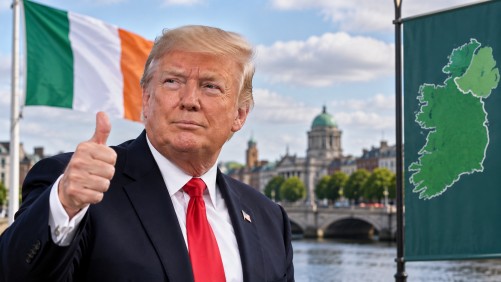
During a visit to Dublin, former US President Donald Trump expressed his support for the unification of Ireland, suggesting that it would be a positive development and might as well happen sooner rather than later. Trump’s comments came after meeting with Irish Taoiseach Micheál Martin and were seen as a notable shift from the neutral stance traditionally held by previous US administrations regarding Northern Ireland’s constitutional status. While Trump acknowledged that the United Kingdom would have a role in such discussions, his remarks sparked immediate reactions from both the UK government and unionist leaders in Northern Ireland.
A spokesperson from Downing Street reiterated the UK government’s position, emphasizing that there is currently not enough support for a referendum on Irish unification under the Good Friday Agreement’s guidelines. Meanwhile, Democratic Unionist Party leader Gavin Robinson emphasized that the decision regarding Northern Ireland’s future should rest with its inhabitants, not external political figures from London, Dublin, or Washington. Robinson maintained his backing for Northern Ireland to remain part of the United Kingdom.
Trump’s statements on Irish unification stand out, given that they diverge from the more neutral approach on the issue typically maintained by past US presidents. Despite the comments, there was no indication that they signified an official shift in US policy toward Northern Ireland. Alongside discussing potential Irish unification, Trump’s visit also included talks on US-Irish economic relations and other international matters.
Trump’s visit to Dublin was met with significant public opposition, as thousands of demonstrators gathered to protest his presence in Ireland. Protesters criticized his policies and called for him to leave the country. After his engagements in Dublin, Trump traveled to his golf resort in County Clare. He was scheduled to attend the Irish Open before heading back to the United States.